The Trust Afterward

Vivienne waited until ten the next morning before messaging Elias.
She had wanted to contact him earlier.
Several times, she had reached for her phone, then stopped. Checking on him was part of the care they had discussed. Flooding him with reassurance because she was uncomfortable with the silence would make the conversation about her needs instead of his.
At ten, she sent the message they had agreed upon before their first scene.
Good morning. No immediate response is required. How are you feeling physically and emotionally today?
His reply did not come at ten fifteen.
Or ten thirty.
By eleven, Vivienne had cleaned the kitchen, watered two plants that did not need watering, and opened a book she had not read a single sentence of.
At eleven seventeen, her phone sounded.
Physically fine. Emotionally embarrassed.
Vivienne read the message carefully.
Thank you for telling me. Do you want reassurance, conversation, space, or something else?
This time, his answer came quickly.
I don’t know.
She considered several responses before choosing the shortest.
That is allowed too. I am here when you decide.
Vivienne placed the phone facedown and returned to her book.
Three minutes later, it sounded again.
Are you angry?
No.
Disappointed?
They had discussed that question the previous evening, but apparently the answer had not survived the night.
Vivienne did not tell him they had already covered it. After an intense experience, people did not always carry every reassurance home intact.
I am disappointed that something you wanted became distressing. I am not disappointed in you for stopping it.
Several minutes passed.
Do you still want to see me?
Vivienne’s fingers hovered over the screen.
The easy response would have been an immediate yes.
The honest response required more.
Yes. I also want us to discuss what happened before another scene. Neither of those things is punishment.
Elias did not answer.
Vivienne let the silence remain.
At noon, she made lunch. At one, she carried a cup of tea into the living room and sat in the same place where Elias had leaned against her after using red.
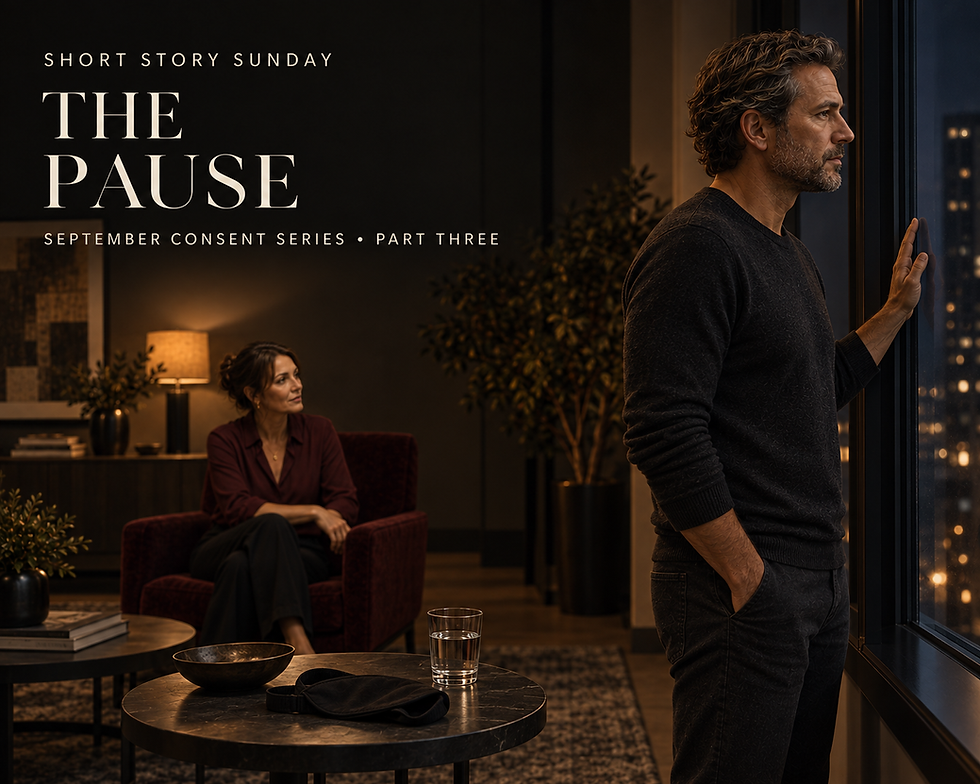
The blindfold was no longer on the table.
She had placed it in the drawer after he left, exactly as she had told him she would. It had not been discarded in anger or returned to the hook with the equipment they expected to use again.
It was simply unavailable until they decided otherwise.
At one twenty-three, another message appeared.
Can we talk today?
Yes. Phone or in person?
In person, if that’s all right.
Four o’clock. Kitchen table. No scene.
The three dots appeared, vanished, and appeared again.
Thank you.
Vivienne arrived at the door before Elias knocked.
When she opened it, he was standing with his hands in his coat pockets. The careful control she usually saw in his posture had been replaced by something guarded.
“Come in,” she said.
He crossed the threshold and looked toward the living room.
The bench remained against the wall. The cuffs were put away. Nothing had been prepared.
His gaze moved to the side table where the blindfold had rested the night before.
It was empty.
“Kitchen,” Vivienne said.
They took their usual seats. Two glasses of water waited between them, along with the leather notebook.
Elias looked at it.
“I thought you might have thrown that away.”
“The notebook?”
“The blindfold.”
“No.”
“Where is it?”
“In a drawer.”
“Are you planning to use it again?”
“Not unless we discuss it and both decide we want to.”
He nodded without looking at her.
Vivienne opened the notebook to a clean page but did not pick up the pen.
“What do you remember about last night?”
“Everything.”
“Tell me.”
Elias leaned back.
“I wanted to try the blindfold. You put it on. At first, I liked it.”
“Yes.”
“The sensations felt stronger. Not knowing when you would touch me or use the paddle was…” He paused. “It was what I thought I wanted.”
“What changed?”
“I still don’t know.”
“What did you notice?”
“My breathing felt wrong. The room felt smaller even though I couldn’t see it. When you moved away, I knew you were still there, but I suddenly didn’t feel sure.”
“Did you believe I had left?”
“No.”
“Did you believe I would hurt you?”
“No.”
“Did you believe you were in danger?”
“No.”
Vivienne waited.
Elias rubbed one palm over the other.
“That’s why I’m embarrassed. Nothing happened.”
“Something happened.”
“Nothing you did.”
“Those statements can both be true.”
He looked at her.
“Something happened inside you,” she continued. “It does not have to be my fault before it matters.”
“I should be able to explain it.”
“Why?”
“Because if I can’t explain it, how do we prevent it from happening again?”
“We do not use the blindfold.”
The simplicity of the answer seemed to unsettle him.
“Ever?”
“For now.”
“What if I never want to use one again?”
“Then we never use one again.”
“You were enjoying it.”
“Yes.”
Elias’s gaze dropped.
Vivienne reached for the pen and wrote a single word across the clean page.
Blindfolds.
Beside it, she added:
Limit unless Elias initiates a new conversation.
She turned the notebook so he could read it.
“That’s it?” he asked.
“That is the boundary you communicated.”
“I didn’t say it was a limit.”
“You do not have to use that exact word. You experienced distress. You remain uncomfortable today. Removing blindfolds from what we do is the reasonable response.”
“What if I change my mind next week?”
“Then we talk next week. The limit remains in place until the conversation happens. You will not be expected to change it.”
Elias read the sentence again.
“I thought you would want me to try it one more time.”
“Why?”
“To prove it wasn’t really a problem.”
“To whom?”
He did not answer.
Vivienne set down the pen.
“Elias, look at me.”
He raised his eyes.
“If you tried the blindfold again because you wanted to understand your reaction, I would listen. If you tried it because you genuinely wanted the experience, I would consider it after another conversation.”
She paused.
“But if you tried it to prove that I should not have to respect your boundary, I would refuse.”
His face tightened. “I’m not trying to make you disrespect it.”
“No. You are trying to make yourself easier to dominate.”
The words settled between them.
Elias looked away first.
Vivienne allowed him time.
“I don’t want to be difficult,” he said.
“A person is not difficult because he has limits.”
“You say that now.”
“I said it before our first scene.”
“It’s different when the limit interferes with something you want.”
“Yes, it is.”
His gaze returned to hers.
Vivienne continued.
“It is easy to claim that boundaries matter when they cost us nothing. Last night, your boundary changed an experience I was enjoying. Respecting it still was not generosity. It was the minimum required of me.”
Elias stared at her.
“You make it sound simple.”
“The action was simple. You said red. I stopped.”
“And the rest?”
“The rest requires honesty.”
He sat quietly for several seconds.
“Then be honest with me,” he said. “Did any part of you resent me?”
Vivienne considered the question before answering.
“I felt concern. I felt disappointed that the scene ended as it did. I wondered whether I had missed signs that I should have noticed earlier. I questioned whether I allowed you too much time to identify what you were feeling instead of removing the blindfold myself.”
“Did you?”
“I don’t know yet.”
“That isn’t what I asked.”
“No,” she said. “I did not resent you.”
His shoulders lowered slightly.
“Do you believe me?”
“I want to.”
“That is not the same thing.”
“No.”
Vivienne closed the notebook.
“What did your former Dominant do when you withdrew consent?”
Elias became still.
The relationship had surfaced in fragments during their conversations, but she had never demanded details.
“She agreed to stop,” he said.
“And afterward?”
“She became quiet.”
“For how long?”
“Sometimes the rest of the night. Sometimes several days.”
“Did she tell you she was angry?”
“No. If I asked, she said everything was fine.”
“But it wasn’t.”
“No.”
“What happened next?”
“She would cancel plans. Or she would say she wasn’t in the mood to talk. If I tried to discuss it, she accused me of making everything about myself.”
Vivienne felt anger move through her, cold and precise.
She did not allow it to alter her voice.
“How did it end?”
“Usually, I offered to do something else.”
“Something you wanted?”
“Not always.”
“And then?”
“She forgave me.”
The final word carried more weight than the others.
Vivienne leaned back.
“You were taught that consent could be withdrawn without punishment as long as you later paid for the inconvenience.”
Elias flinched.
“I didn’t think of it that way.”
“That does not make it less true.”
“Maybe she needed space.”
“People are allowed to need space. They are not entitled to use withdrawal as leverage while denying that anything is wrong.”
He looked toward the living room.
“I kept waiting for your message last night.”
“What message?”
“The one telling me not to come back.”
“Was that why you asked whether I still wanted to see you?”
“Yes.”
Vivienne reached across the table but stopped before touching his hand.
“May I?”
Elias looked at the small distance between them, then turned his palm upward.
Vivienne placed her hand over his.
“You do not have to earn your way back from saying red.”
His fingers closed around hers.
“You say things like that as if they should be obvious.”
“They should be.”
“They aren’t.”
“No,” she said. “Not yet.”
He looked down at their hands.
“What happens next?”
“Today, we continue talking until one of us wants to stop.”
“And after today?”
“We decide whether we both want another meeting.”
“You said you still wanted to see me.”
“I do. I am asking you to decide whether you still want to see me.”
His head lifted.
“You think I might not?”
“I think last night affected you. I will not treat your desire to continue as automatic simply because you came here.”
Elias was quiet.
Vivienne did not fill the silence with reassurance.
After a moment, he asked, “If I say no, what happens?”
“I accept the answer.”
“And if I say yes?”
“We discuss what yes means.”
A faint smile appeared. “Another conversation.”
“Many of them.”
“I’m beginning to understand that.”
They talked for another hour.
They discussed the difference between immediate aftercare and the support someone might need the following day. Elias admitted he had slept poorly and replayed the moment he said red until it sounded like failure in his memory.
Vivienne told him she had also replayed the scene—not to build a case against him, but to consider what she might do differently.
She asked whether her message that morning had arrived too early, too late, or at the right time. He told her the timing had been right, but the phrase no immediate response required had mattered more. It allowed him to answer when he knew what he felt instead of producing reassurance for her.
He asked what she had needed after the scene ended.
Vivienne paused.
It was the first time he had asked.
“I needed to know you were physically safe,” she said. “I needed honesty from you. After you left, I needed time to think.”
“Did you have anyone to talk to?”
“No.”
“Would that have helped?”
“Perhaps.”
Elias studied her face.
“I thought aftercare was something you gave me.”
“It is care for everyone affected by the scene. Our needs may be different, but mine do not cease to exist because I was in control.”
“What would you want from me next time?”
“Clear information. If you are able, tell me what you need rather than making me guess. The next day, answer the check-in honestly. Do not reassure me by pretending you are fine.”
“I can do that.”
“You can try.”
He smiled. “You don’t accept many promises.”
“I prefer patterns.”
Before he left, they agreed to meet the following Saturday for dinner.
No scene was planned.
When Saturday arrived, Elias brought dessert from the bakery near his apartment. Vivienne made dinner. They ate at the kitchen table without opening the notebook.
For the first hour, neither mentioned the blindfold.
It was Elias who finally did.
“I don’t want to use it again.”
Vivienne set down her glass.
“All right.”
“I thought about whether I might want to try eventually. I kept looking for a reason that would make the answer feel more acceptable.”
“You do not need one.”
“I know.”
This time, he sounded as though he might believe it.
“Do you want blindfolds recorded as a hard limit?” she asked.
“Yes.”
“I will update the notebook.”
“That’s all?”
“That’s all.”
Elias smiled.
After dinner, they carried their glasses into the living room. Vivienne sat in her usual chair.
Elias remained standing.
“May I ask for something?” he said.
“Yes.”
“I would like to kneel.”
Vivienne watched him carefully.
“Why?”
“Because the last time I knelt here, I knew I could get up. I want to feel that again.”
“No restraints?”
“No.”
“No impact?”
“No.”
“No blindfold?”
He met her gaze.
“No blindfold.”
“Then you may kneel.”
Elias lowered himself onto the cushion at her feet. His hands rested loosely on his thighs.
Vivienne did not touch him immediately.
“What color?”
“Green, Ma’am.”
“What does green mean?”
“That I want this now.”
“And five minutes from now?”
“You ask me again.”
Vivienne rested her hand against his hair.
His eyes closed.
The room became quiet—not with the strained silence he had once learned to fear, but with something chosen.
Several minutes passed.
“What color?” she asked.
“Green.”
She continued touching him, slowly and without demand.
When she checked again, his answer remained the same.
Not because it had to.
Because it was still true.
Elias leaned slightly against her knee.
Vivienne looked down at the man who had once believed that boundaries made him difficult, stopping made him disappointing, and submission required him to become easier for someone else to use.
He had said red.
She had respected it.
The connection between them had not broken beneath the weight of that boundary.
It had become more honest.
More deliberate.
Stronger.
Trust had not been created because Elias never needed to stop her.
It had been created because he had—and she had stopped.



Comments