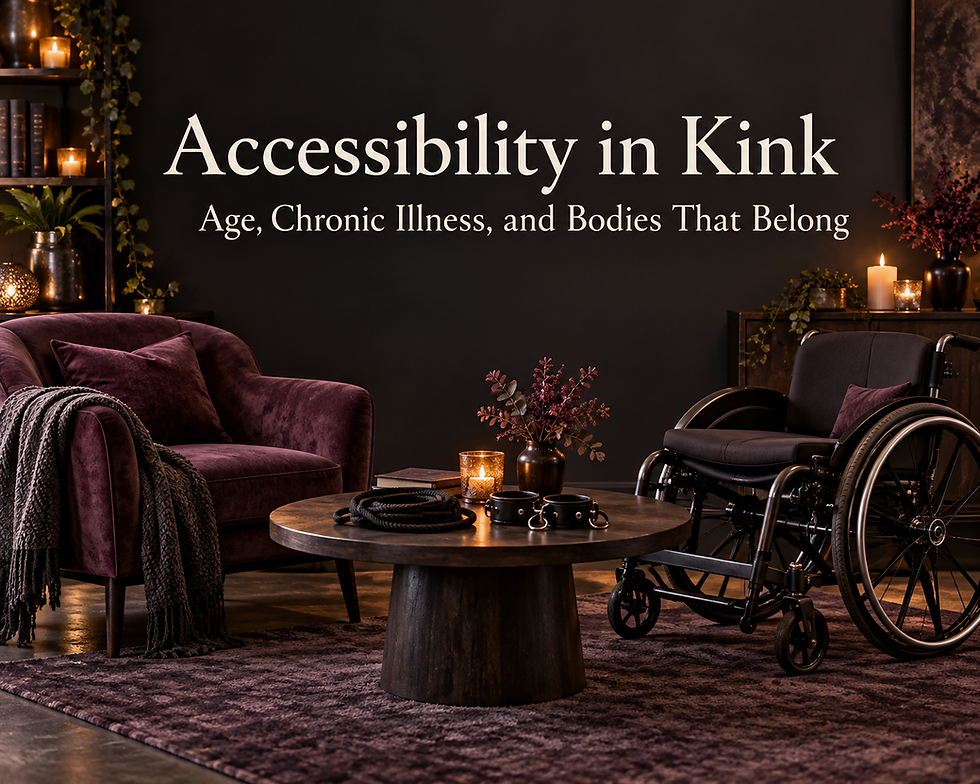
Accessibility in Kink

Age, Chronic Illness, and Bodies That Belong
There is a persistent image of what a BDSM practitioner is supposed to look like: physically strong, endlessly energetic, flexible enough for demanding positions, and able to recover from intense play without much disruption. The dominant stands confidently through a long scene. The submissive kneels comfortably, holds a position, and tolerates increasing intensity. Neither needs a chair, a mobility aid, an unexpected break, or a change of plans.
That image leaves out many of the people who actually make up the community.
Older adults, people with chronic illnesses, and people with physical disabilities participate in kink as dominants, submissives, switches, educators, organizers, and partners. Their bodies are not interruptions to an otherwise ideal scene. Their access needs are part of planning an encounter between the people who are actually present.
Accessibility asks us to examine more than whether someone can enter a venue. It asks whether they can participate, communicate, rest, use the facilities, and leave safely. It also asks whether they will be treated as a desirable adult with agency—or as a problem someone else needs to manage.
When high-intensity physical play enters the discussion, the answer cannot be that everyone should push harder. Nor should it be that anyone with a health condition must abandon intensity altogether. The more useful questions are what a particular person wants, what their body can tolerate under current circumstances, and what risks or barriers need attention.
The “Perfectly Able-Bodied” Practitioner Is a Narrow Ideal
The stereotype often appears through ordinary expectations rather than explicit exclusion. A workshop assumes everyone can sit on the floor. A ritual requires prolonged kneeling. A demonstration uses positions that depend on balance, grip strength, or joint mobility. An event offers nowhere to rest except equipment reserved for scenes.
Nobody may announce that disabled or chronically ill participants are unwelcome. Yet the structure tells them that participation requires a body different from their own.
The CDC identifies physical, communication, attitudinal, transportation, and policy barriers as factors that can restrict inclusion. That framework is useful for kink communities because a welcoming statement does little if the environment still prevents someone from participating. CDC
The stereotype also shapes how people interpret authority and submission. A dominant who sits during a scene may be perceived as less commanding. A submissive who cannot kneel may be treated as insufficiently devoted. Someone who needs a shorter encounter may feel that they have failed to provide the experience their partner expected.
Those judgments attach meaning to a physical performance without considering why it may be unavailable. Authority can be expressed while seated. Submission does not require a particular joint position. A scene can be satisfying without exhausting everyone involved.
A community that values negotiation should be capable of negotiating those details too.
Age Does Not Determine Desire or Ability
Aging can change the way someone approaches physical activity, intimacy, and recovery. It does not provide a complete description of their interests or capabilities. An older practitioner may enjoy demanding play, prefer less physically strenuous activities, or have interests that change over time. A younger practitioner may have substantial access needs.
The National Institute on Aging recognizes that sexuality and intimacy can remain meaningful in older adulthood while health conditions, medications, and physical changes may affect how people experience them. Open communication and adapting to individual circumstances remain important. National Institute on Aging
Within kink, age should prompt curiosity rather than assumptions. “What works for you?” is more useful than deciding that someone must have outgrown an interest or should be protected from it without being consulted.
Age can also intersect with expectations about appearance. Older bodies may be welcomed as sources of experience while being overlooked as desirable partners. Compliments that express surprise—surprise that someone still enjoys kink, still dates, or still has confidence—can reveal the assumption beneath them.
People do not need to preserve a younger appearance or reproduce their earlier physical performance to remain legitimate participants. Changing a position, reducing a scene’s duration, or allowing more recovery time can reflect informed judgment. Experience has value partly because it can help a person recognize when yesterday’s approach no longer serves them.
Chronic Illness Can Make Capacity Unpredictable
Chronic illness may involve symptoms that vary across days or within a single day. Someone may be able to attend an event but lack the energy to play once they arrive. They may feel comfortable during negotiation and need to revise the plan later. Their appearance may give little indication of the effort required to participate.
That variability can create tension when a partner treats plans as commitments that must be fulfilled regardless of changing circumstances. “You were fine earlier” does not establish what someone can do now. Neither does pointing to an activity they managed last week.
A practical approach leaves room for more than one outcome. Partners can discuss a preferred scene, a less demanding alternative, and the possibility of spending time together without play. Those options should be real choices rather than a hierarchy in which the least strenuous one is treated as a disappointment.
The cost of participation may extend beyond the scene itself. Travel, getting ready, standing in line, socializing, and returning home can consume capacity before physical play is considered. Recovery may also interfere with work, household tasks, or other responsibilities afterward.
For someone whose condition involves delayed worsening after exertion, feeling capable in the moment may not tell the whole story. Their established care guidance and previous experience matter. A partner should not encourage them to override that knowledge simply because the scene appears to be going well.
A sustainable encounter considers the person’s life beyond the room.
Disability Does Not Remove Agency
People with physical disabilities are sometimes treated as though their access needs imply an inability to make adult decisions. A partner may become overly protective, speak for them, or refuse to discuss their interests without first considering what they are actually asking for.
Disability alone does not establish an inability to consent. Someone who uses a wheelchair, communicates differently, or needs assistance with a transfer may still understand the proposed activity and make informed choices about it.
Respecting that agency does not mean ignoring risk. It means discussing risk with the person rather than treating them as absent from the decision. Their knowledge of their body is essential, while a partner also needs to understand the limits of their own skills and information.
It is reasonable for a top to decline an activity they cannot perform responsibly. It is not reasonable to disguise assumptions about disability as expertise. “I do not know how to manage that risk” is an honest statement. “People like you cannot do this” makes a much broader claim.
Partners need room to identify an incompatibility without turning it into a judgment about someone’s worth. A particular scene may not be workable between particular people. That does not make the disabled participant unsuitable for kink.
High Intensity Requires Individual Assessment
High-intensity physical play deserves careful consideration because an adaptation that improves comfort may not address the underlying risk. Padding, shorter duration, or a different position can be useful in some circumstances, but none automatically makes an activity appropriate for every body.
Depending on the individual, relevant concerns may include joint instability, reduced sensation, skin vulnerability, circulation problems, fatigue, balance, or difficulty tolerating a position. Medication effects may matter too. A diagnosis by itself rarely provides enough information to determine what a particular scene will involve.
Reduced sensation, for example, can make pain an unreliable warning sign. A person’s willingness to continue does not necessarily tell a partner whether tissue or nerves are being stressed. Similarly, being able to hold a position briefly does not establish that maintaining it under restraint will be tolerable.
Where these concerns apply, a clinician familiar with the person’s condition may help clarify restrictions. Describing the physical demands directly—pressure, restraint, prolonged standing, impact, or exertion—can make that conversation more useful. A clinician may not be able to approve a specific kink activity, but they may be able to identify relevant medical limits.
Some activities should be avoided rather than modified. Accessibility includes being honest about those limits. It also includes exploring other ways to achieve a desired experience without promising that every technique can be made suitable.
Intensity Is More Than Physical Endurance
The community often measures intensity through visible physical demands: how long a scene lasts, how forceful it becomes, or how much a participant appears to withstand. That measure overlooks the importance of anticipation, attention, ritual, trust, and the meaning participants give an encounter.
A physically modest scene may feel profound to the people involved. A dominant can create a compelling dynamic through pacing and communication. A submissive can experience surrender without maintaining a painful position or accepting escalating force.
This does not mean psychological intensity is automatically low risk. Emotionally demanding play still requires specific negotiation and can have significant effects. Replacing a physical activity with an emotionally charged one is not a universal safety solution.
The point is that partners can identify what they actually want from a scene before deciding how to pursue it. Is the desired experience focused attention, sensation, restraint, service, vulnerability, or a particular ritual? Some elements may be adaptable. Others may be essential to one person and incompatible with another’s limits.
That discussion creates more possibilities than assuming physical endurance is the standard by which every encounter must be judged.
Negotiate Function, Not Just Diagnoses
A diagnosis may help explain an access need, but practical negotiation requires information about what happens during the proposed activity. “I have a chronic illness” is less specific than “I need to remain seated,” “My grip can become unreliable,” or “I cannot tolerate pressure in that area.”
Participants should discuss positions, duration, communication methods, assistance, and what should happen if capacity changes. A top’s needs belong in that conversation too. Limited strength, pain, fatigue, or balance can affect equipment handling and the ability to respond quickly.
Nobody owes the room a complete medical history. A partner does need enough relevant information to make an informed decision about participating. Those needs can coexist: someone can protect unrelated private details while clearly explaining restrictions that affect the scene.
Existing symptoms also deserve attention. If pain, fatigue, or dizziness is part of someone’s usual experience, partners should discuss what changes mean the activity needs to stop. A safeword remains useful, but it cannot replace responding to impaired communication or a concerning change in condition.
Negotiation should make adjustment easier. It should not require someone to defend the legitimacy of their needs each time they arise.
Communication Must Be Accessible
A consent system works only when everyone can use it. A verbal safeword is insufficient if a participant cannot speak reliably under the planned conditions. A hand signal may be unsuitable if it depends on movement or strength they do not have.
Partners should agree on a communication method that fits the person and the activity, then check that it remains available throughout. If restraint, positioning, noise, or sensory limitations interfere with that method, the scene needs a different plan.
Difficulty speaking should not be mistaken for lack of understanding. A participant may need more time, written communication, or an assistive device. Give them room to communicate without allowing another person to answer on their behalf unless they have explicitly requested that support.
At events, captions, interpreters, readable materials, and appropriately lit teaching spaces can improve access. NCSF’s accessibility resources include discussion of disability and interpreter access within BDSM communities, recognizing that participation depends on more than physical entry. National Coalition for Sexual Freedom
Communication access should be established before an intense moment arrives. Consent cannot depend on a system that the scene itself makes unusable.
Care and Control Need Clear Boundaries
Assistance can be necessary without being part of a power exchange. Helping someone transfer, retrieving a mobility aid, or supporting a care routine does not automatically make that assistance dominant, submissive, or erotic.
Partners should discuss whether any caregiving overlaps with their dynamic and where it does not. Essential help should never become leverage for obtaining participation. Someone must remain able to refuse play without fearing that practical assistance will be withheld.
Mobility aids and medical equipment are personal items. Touching, moving, or using them as props requires permission. A wheelchair should not be assumed to be restraint equipment, and an assistive device should remain available when the person needs it.
Planning also needs to cover how a scene ends. If a participant requires help changing position or transferring, that assistance must be within the helper’s competence and agreed upon. A top whose own capacity could become limited needs a workable response plan as well.
The purpose is to preserve choice throughout the encounter. Dependence on assistance should not create dependence on someone’s approval.
An Accessible Venue Needs More Than an Accessible Entrance
An event can have a step-free entrance and still be difficult to use. Restrooms may be inaccessible. Passageways may be obstructed. Seating may be scarce. Equipment may require transfers that are not possible for some attendees. There may be no comfortable place to rest without leaving the event.
Organizers can help by publishing concrete information. Details about entrances, stairs, restroom access, seating, parking, lighting, sound, and routes through the space allow people to assess the venue before committing time, money, and energy. “Contact us with questions” is useful, but it should supplement information rather than replace it.
Emergency exits and evacuation plans matter too. Accessibility should extend through the person’s whole visit, including an unexpected departure. Staff need to know how to respond without assuming that every attendee can move quickly or use stairs.
Scheduling can create barriers as well. Long sessions without breaks, late-night-only events, and rigid cancellation policies may exclude people with fatigue or fluctuating symptoms. Offering rest opportunities and considering flexible participation can widen access.
Disabled members should be involved in planning and evaluation. The CDC identifies their input as part of meaningful inclusion, alongside removing barriers and changing discriminatory attitudes. CDC
Organizers will not be able to meet every need immediately. Accurate information, responsiveness, and a clear effort to improve are still more useful than broad claims that conceal limitations.
Adaptation Should Not Require an Apology
Accessibility is undermined when someone receives an accommodation but is made to feel burdensome for using it. A chair offered with irritation, a break treated as an inconvenience, or a modified position described as “less real” sends a message about who belongs.
Partners and communities can change that by making needs ordinary subjects of negotiation. Seating, pacing, rest, and communication methods should be discussed with the same seriousness as other scene details. A person should not have to demonstrate exceptional toughness to compensate for needing support.
Ending early should be accepted without a disappointed performance from the other participant. A submissive’s limit should not be interpreted as a failure of devotion. A dominant’s need to sit or pause should not become a challenge to their authority.
Representation matters as well. Older and disabled practitioners should appear as participants, educators, and desirable adults, without every appearance being framed as an inspirational achievement. They can share expertise, enjoy an encounter, or attend an event for the same varied reasons as anyone else.
Belonging should not depend on hiding an aid, minimizing symptoms, or proving that someone can pass as able-bodied.
Aftercare Includes What Happens Later
Aftercare should reflect individual needs rather than a fixed script. Someone may want quiet, help gathering belongings, time to recover before moving, or access to their established care routine. Another person may prefer space and no touch.
For participants with chronic illness or physical disability, the plan should consider what happens after leaving. Transport, fatigue, delayed symptoms, and access to assistance can affect whether an otherwise enjoyable encounter is manageable.
A later check-in can help partners assess the actual cost of a scene. “Was the recovery what you expected?” may reveal information that “Did you enjoy it?” does not. An experience can be pleasurable and still require changes before it is repeated.
A good outcome should inform future planning without becoming a guarantee. Likewise, a difficult recovery can justify reducing demands or stopping an activity without requiring someone to prove that the scene was a mistake.
The aim is participation that works within the person’s life, with room to learn and revise.
Bodies Do Not Need to Qualify for Belonging
Accessibility in kink requires practical changes and a change in expectations. It asks communities to stop using youth, endurance, flexibility, or physical strength as evidence that someone is a more legitimate practitioner.
Age, chronic illness, and disability can affect what a person needs and which activities are suitable. They do not define the whole person, determine their role, or erase their desires. Good negotiation begins with the individual rather than the stereotype.
High-intensity play may remain possible for some people, require substantial changes for others, or be an activity someone chooses to leave behind. None of those outcomes establishes how much they belong.
A community committed to consent can make room for chairs, aids, shorter scenes, changing plans, and honest refusals. It can build spaces where people are able to participate without pretending to have a different body.
The people already present should be the starting point for that work.


Comments